social media advertising
Blog

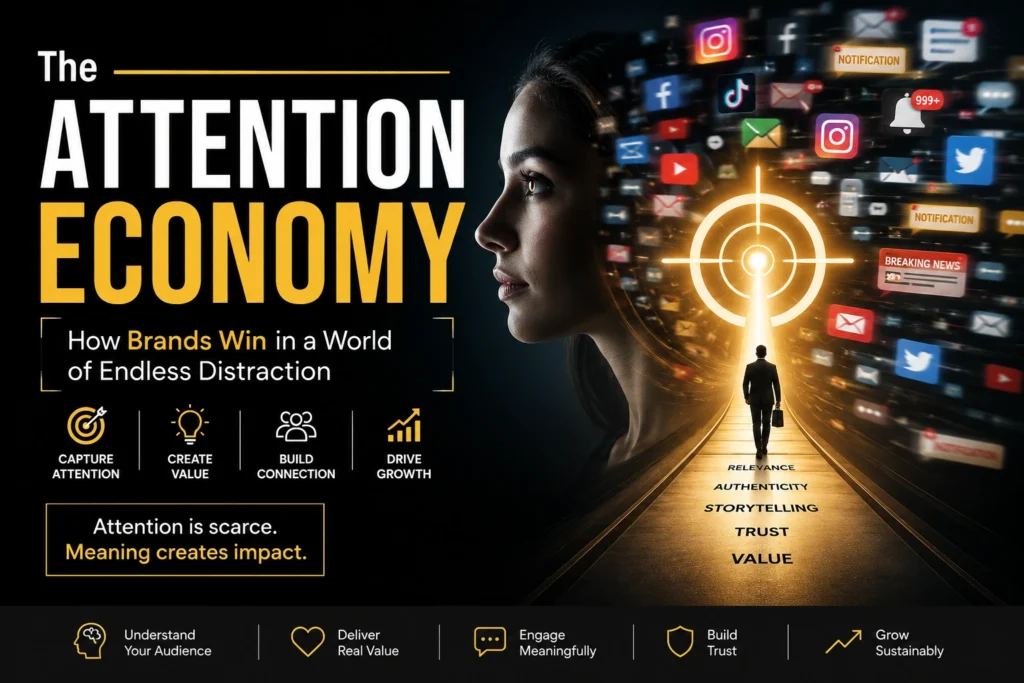
The Attention Economy: How Brands Win in a World of Endless Distraction

The New Currency: Attention In today’s digital environment, attention is among the most prized assets for companies. Every day, consumers are exposed to thousands of messages, ads, videos, notifications, emails, and social media updates. Therefore, brands now compete beyond just market share or purchasing power. They vie for a limited share of human attention. This environment has given rise to what marketers refer to as the attention economy, in which the capacity to capture and hold attention directly affects brand visibility, engagement, and growth. Moreover, consumers are becoming more selective about what merits their attention. They can breeze past an ad in seconds, skip a video after just a few moments, or overlook content that doesn’t seem immediately relevant. Thus, conventional marketing methods that rely solely on repeated exposure are growing less effective. Today, successful brands need to craft experiences that naturally attract attention instead of just demanding it. Why Attention Has Become So Difficult to Capture The contemporary consumer navigates a setting rife with ongoing distractions. Smartphones offer immediate access to social media, entertainment, news, shopping, messaging, and a wide array of other digital activities. As a result, each notification vies with another piece of information for the user’s attention. This ongoing competition has diminished the natural, undivided attention people typically give to individual brands. In addition, digital platforms have simplified content creation more than ever before. Every day, millions of businesses and creators release new content. While this development opens up opportunities, it also leads to significant content saturation. Even with a great product, a brand can go unnoticed if its message doesn’t capture attention. Therefore, marketers need to recognize that being visible does n’t ensure attention, and having attention does n’t automatically lead to action. From Visibility to Valuable Engagement For many years, marketers placed strong emphasis on visibility. Companies evaluated impressions, reach, website traffic, and ad exposure to assess if their campaigns were successful. Nevertheless, contemporary marketing demands a more in-depth strategy. Just because someone sees a brand’s content doesn’t mean they’ll remember it, trust it, or plan to buy from it. Rather, brands ought to prioritize meaningful engagement. Good content should prompt people to pause, reflect, engage, educate themselves, or take action. For instance, an informative video can address a problem, whereas a compelling story can foster an emotional connection. In the same way, an interactive social media campaign can transform passive viewers into active participants. Thus, brands should assess not just how many people view their content, but also what actions those viewers take afterward. The Psychology Behind Winning Attention Attention is closely linked to human psychology. People instinctively pay attention to information that seems relevant, surprising, emotional, useful, or personally significant. Therefore, brands that grasp audience psychology can craft messages that organically draw attention. A compelling headline, a surprising visual, a story that resonates, or a clear promise to solve a problem can quickly boost the chances of engagement. However, drawing attention should not be used as a justification for manipulation. Clickbait might bring in quick traffic, but deceiving audiences can harm credibility in the long run. Thus, successful brands strike a balance between intrigue and genuineness. They first capture people’s attention and then provide real value once that attention is gained. In this way, attention serves as the starting point of a relationship rather than a fleeting marketing tactic. Storytelling: The Brand Advantage Storytelling continues to be one of the most effective ways to stand out in the attention economy. People might forget statistics, product specs, or advertising slogansbut they frequently remember stories that evoke emotional bonds. A well-crafted brand story can convey purpose, personality, values, and identity more effectively than traditional advertising typically can. In addition, storytelling enables businesses to involve their audiences in the narrative. Rather than just claiming a product is useful, a brand can show how it transforms someone’s experience. Sharing customer success stories, behind-the-scenes glimpses, founder narratives, and community tales can help businesses seem more relatable and human. Therefore, storytelling can turn a company from a product provider into a well-known and unforgettable brand. Creativity Is No Longer Optional In a saturated digital landscape, creativity now serves as a key competitive edge. Brands can’t depend on generic promotional messages and assume audiences will remember them. Instead, they need to create unique visual identities, fresh ideas, compelling formats, and distinct communication styles. Creativity enables a brand to establish a mental connection that rivals find difficult to replicate. Moreover, creative marketing doesn’t always demand a huge budget. A straightforward concept can prove very effective if marketers grasp their audience and convey the message clearly. Short-form videos, eye-catching graphics, informative carousels, engaging polls, standout campaigns, and content tailored to cultural contexts can all draw attention. Thus, creativity must aim not just at visual appeal but also at conveying a meaningful and memorable message. The Power of Short-Form Content Short-form content has changed how brands interact with audiences online. Platforms centered on short videos have conditioned viewers to digest content rapidly. Therefore, brands need to convey their central message within a short timeframe. This does not imply that every message needs to be shallow. Instead, marketers need to master the skill of conveying valuable information in an efficient manner A successful short-form video typically starts with a compelling hook, includes valuable or engaging content, and concludes with a clear message or call to action. For instance, a digital marketing agency could start with a statement like, “ Your website may be losing customers for one simple reason,” followed by an explanation of the issue. This structure sparks curiosity while also providing value. Thus, short-form content can serve as a potent tool when brands integrate speed, relevance, and substance. Personalization: Making Attention Feel Relevant Consumers are more inclined to interact with content that aligns with their interests, needs, and situations. As a result, personalization is becoming increasingly crucial in contemporary marketing. Rather than delivering the same message to all audiences, brands can leverage customer insights to craft more personalized experiences. Tailored
freelance wordpress developer
Blog

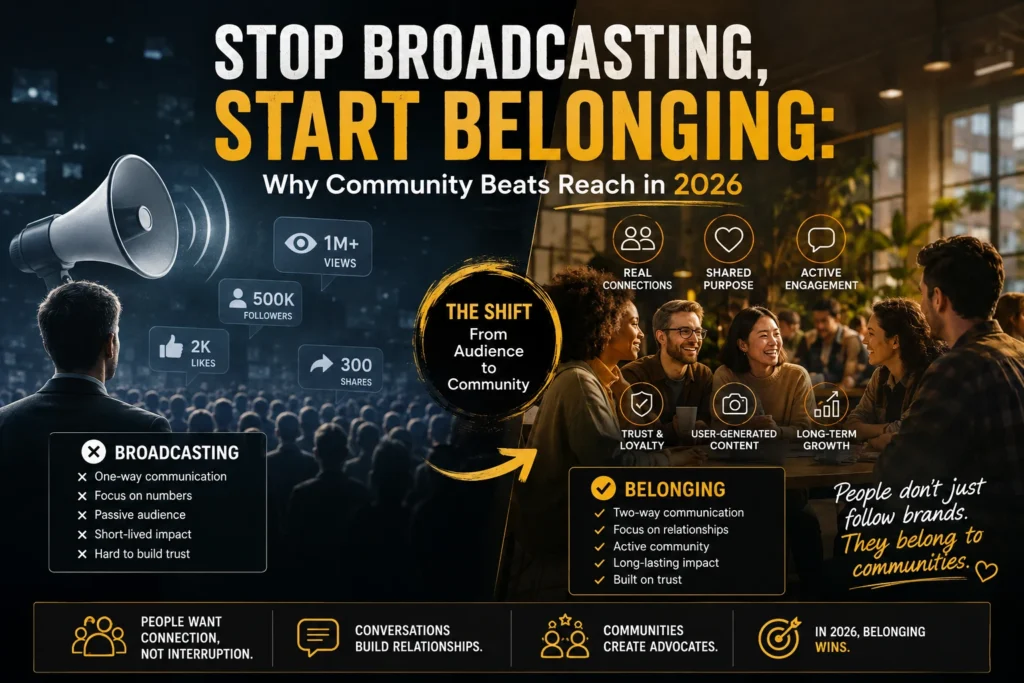
Stop Broadcasting, Start Belonging: Why Community Beats Reach in 2026

The End of the Megaphone Era For years, digital marketing operated on a straightforward formula: maximize reach, drive impressions, and turn a portion of those viewers into customers. Brands poured significant resources into advertising, influencer partnerships, viral content, and expanding their follower base, as high numbers seemed to equate with success. Nevertheless, the digital landscape has undergone substantial change. By 2026, viewers face more options, more streaming services, and more content vying for their attention than at any previous time. As a result, merely broadcasting a message to a broad audience no longer ensures meaningful engagement. Rather than broadcasting, successful brands are shifting toward fostering a sense of belonging. They are building communities in which people go beyond consuming content to engage in conversations, share experiences, swap ideas, and form connectionsboth with the brand and with each other. Therefore, the most effective marketing strategy is no longer focused on asking, “ How many people can we reach?” It’s about asking, “ How many people truly desire to belong?” Reach Looks Powerful, but Connection Creates Value Reach continues to be a key marketing metric. A campaign targeting thousands or millions of people can raise awareness and bring a brand to new audiences. However, reach alone doesn’t indicate if people remember the message, trust the company, or are inspired to act. Someone can breeze past an ad in seconds without forming any real connection with the brand. In contrast, community fosters more profound levels of engagement. People in a strong community willingly get involved because they see worth in the experience. They can leave comments on posts, respond to questions, suggest products, join events, produce user-generated content, or assist other members. Therefore, community engagement can turn passive viewers into active supporters who help drive sustained brand growth. What Does Belonging Really Mean in Marketing? Belonging means more than just having followers. A follower might encounter a brand’s content from time to time, while a community member identifies with a common identity, purpose, interest, or experience. For instance, a fitness brand might foster a community centered on healthy living, whereas a tech company could cultivate a group focused on innovation and knowledge sharing. In both instances, the community offers a reason for people to come backeven if they aren’t prepared to buy. Moreover, membership fosters emotional significance. People inherently desire to feel understood and accepted. When brands provide platforms for audiences to voice opinions, exchange experiences, and connect with like-minded individuals, they transcend their role as mere commercial entities. They become integrated into their customers’ identities and daily routines. Thus, community marketing works because it fulfills both practical needs and emotional drivers. From Audience to Community: A Fundamental Shift An audience mainly receives information. A community is engaged in a continuous relationship. This difference might seem minor, but it fundamentally alters how brands communicate. Traditional broadcasting typically operates on a one-way model where the brand delivers a message and the audience passively receives it. Community-led marketing, however, fosters a two-way or even multi-directional dialogue. Therefore, brands need to cease viewing customers as mere data points on an analytics dashboard. They ought to listen to questions, grasp concerns, acknowledge contributions, and engage with conversations. A community grows stronger when its members believe their input shapes the brand’s path. Thus, businesses ought to foster opportunities for involvement rather than persistently broadcasting promotional content. Why Community Beats Follower Count A large follower count may generate social proof, but it does n’t necessarily lead to loyalty. A large number of inactive followers may contribute less business value than a smaller group of highly engaged customers. For this reason, marketers in 2026 should focus more on engagement quality than on vanity metrics. For instance, a brand boasting 10,000 actively involved community members might produce more recommendations, repeat buys, referrals, and user-created content than a brand with 500,000 inactive followers. In addition, communities that are actively involved can help narrow the gap between brands and customers. Members have the opportunity to serve as educators, advocates, reviewers, and unofficial brand representatives. Therefore, communities can build a marketing ecosystem that expands beyond the company’s own communication channels. The Rise of Micro-Communities The internet enables individuals with very niche interests to connect across geographical boundaries. Consequently, large general audiences are increasingly being supplemented by smaller, more targeted communities. These micro-communities frequently foster stronger connections since members commonly share focused interests, difficulties, objectives, or identities tied to a specific topic. This development presents a significant opportunity for brands. Rather than trying to appeal to everyone, businesses can foster meaningful relationships with clearly defined segments. For example, a skincare brand might build a community centered on educating users about skincare rather than just pushing products. Likewise, a digital marketing company might establish a platform where entrepreneurs can exchange ideas on advertising, content creation, SEO, and social media strategies. As a result, niche communities can foster greater trust and more robust commercial relationships. Content Should Start Conversations, Not End Them Traditional content marketing typically centers on providing information. A brand releases a blog post, video, carousel, or ad and then proceeds to the next piece of content. However, community-driven content operates on a different principle: it should foster opportunities for conversation. Thus, brands ought to create content that encourages engagement from people. Features like questions, polls, challenges, discussions, live sessions, opinion-driven posts, community stories, and user-created content can boost engagement. Rather than just stating what the brand believes, businesses should provide audiences with chances to share their own viewpoints. Therefore, content serves as the foundation for building relationships rather than merely concluding a marketing message. Trust Is the Real Competitive Advantage Consumers are becoming more wary of marketing claims. They come across sponsored posts, ads, influencer endorsements, AI-created content, and branded messages on nearly every digital platform. As a result, trust has emerged as one of the most valuable assets a brand can cultivate. Community offers a setting in which trust can grow over time. Members can see how a company deals with criticism,

content marketing
Blog

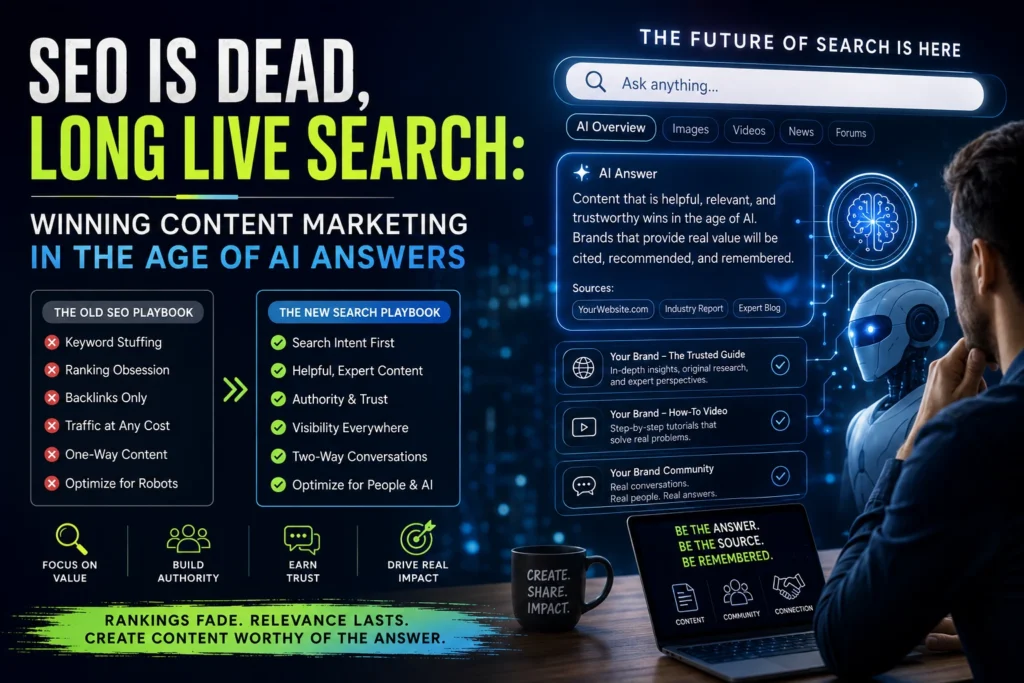
SEO Is Dead, Long Live Search: Winning Content Marketing in the Age of AI Answers

SEO Is Not Dead—The Old Rules Are For over twenty years, search engine optimization ( SEO) has served as one of the most critical pillars of digital marketing. Companies enhanced their websites by targeting keywords, acquiring backlinks, boosting page load times, and producing blog posts to achieve better rankings in search engine results. Nevertheless, the search experience has undergone a significant transformation. Today, users more often anticipate straightforward answers instead of just a collection of links. Artificial intelligence is speeding up this transformation by enabling users to find information via conversational responses, summaries, suggestions, and intelligent search experiences. Thus, claiming that “ SEO is dead” is overly dramatic and inaccurate. While traditional SEO methods are evolving, the core goal of search continues to be the same: assisting users in discovering useful, reliable, and pertinent information. What has changed is the way users find that information and how search platforms choose, summarize, and display it. Therefore, marketers need to go beyond targeting keywords and begin focusing on enhancing visibility, authority, relevance, and usefulness throughout the entire search ecosystem. Welcome to the Age of AI Answers Artificial intelligence has added a new dimension to online search. Rather than entering multiple keywords into a search bar and visiting several sites, users are increasingly able to ask full questions and get concise answers. AI-driven systems can integrate data from various sources, detect patterns, and deliver information in a conversational style. This change presents both difficulties and possibilities for content marketers. Users may get answers without needing to navigate to traditional search results. Conversely, brands that create authoritative and valuable content can serve as references, summaries, or recommendations for AI systems. Thus, the goal is no longer merely to appear on page one. Brands need to produce content that merits being found, comprehended, trusted, and cited From Keywords to Questions: Understanding Search Intent Keywords are still important, but they aren’t enough on their own. Today’s search behavior is becoming more focused on the user’s intent. Users seek problem solutions, clear explanations of difficult topics, product comparisons, advice, and actionable guidance. Therefore, marketers need to grasp what a person truly seeks when they conduct a search. For instance, a person looking for “ digital marketing” might just be seeking a definition. Another person searching for “ best digital marketing strategy for a small business” likely has a more commercial or practical motivation. Thus, content must respond to the particular need driving the query. By recognizing users’ informational, navigational, commercial, and transactional intent, companies can develop content tailored to their position in the customer journey. The New Battlefield: Search Everywhere Searching is no longer limited to traditional search engines. More and more people find information via social media, video sites, online communities, marketplaces, forums, podcasts, mapping services, and AI assistants. Therefore, brands must look beyond traditional search engine rankings. This development has led to what might be called search everywhere optimization. A customer could stumble upon a brand via a Google search, view its videos on YouTube, read reviews or conversations about it on Reddit, browse its Instagram page, and finally turn to an AI assistant to evaluate different options. Thus, companies should ensure consistent information and solid authority across various digital platforms. The future of search favors brands that stay visible wherever audiences seek answers. Content Quality Has Become the Ultimate Ranking Strategy As AI accelerates and reduces the cost of content creation, the internet will host an even greater volume of articles, videos, posts, and automated responses. Therefore, producing large volumes of generic content will offer diminished competitive advantage. Rather than focusing on other factors, marketers should emphasize originality, accuracy, expertise, experience, and usefulness. Content that is of high quality should address an actual problem instead of merely aiming for a keyword. It should clarify concepts, offer practical examples, share original insights, and address the actual questions users are asking. Moreover, compelling content should explain why the brand possesses the expertise or background to address the topic. In a setting saturated with machine-generated content, genuine expertise can emerge as one of the most valuable ways to stand out. E-E-A-T: Building Content People and Platforms Can Trust Trust is growing more critical in today’s search landscape. Google’s widely recognized E-E -A-T frameworkExperience, Expertise, Authoritativeness, and Trustworthinessoffers marketers a helpful approach to evaluating content quality. While E-E -A -T isn’t a simple checklist that ensures rankings, its principles capture a key truth: search ecosystems rely on trustworthy information. Thus, businesses ought to show genuine expertise by featuring qualified authors, conducting original research, drawing on firsthand experience, providing accurate information, citing transparent sources, and presenting clear business details. For instance, a professional service firm can enhance its content by sharing expert analysis, case studies, useful guides, and real customer stories. Over time, these signals can help position the brand as a trustworthy source instead of just another site vying for clicks. Create Content Worth Citing In the era of AI-generated answers, being cited or referenced can hold as much value as getting a traditional search click. AI systems require accurate data to generate helpful responses. Thus, brands ought to produce content that offers compelling evidence, unique insights, straightforward explanations, and information that other sources can rely on confidently. Original research holds special value in this setting. Surveys, statistics, case studies, expert interviews, industry observations, proprietary data, and unique frameworks can provide content with a competitive edge. Likewise, clearly organized guides that address key questions directly can serve as valuable reference materials. Therefore, marketers should stop focusing solely on the question, “ How can I rank this article?” and begin to ask, “ What unique contribution does this article offer that other pages lack?” The Rise of Answer Engine Optimization The rise of AI-powered search has prompted marketers to consider Answer Engine Optimization ( AEO). While traditional SEO primarily aims to help search engines find and rank webpages, AEO is designed to make information easier for systems to interpret and apply when delivering direct answers. To back this

Scroll to Top