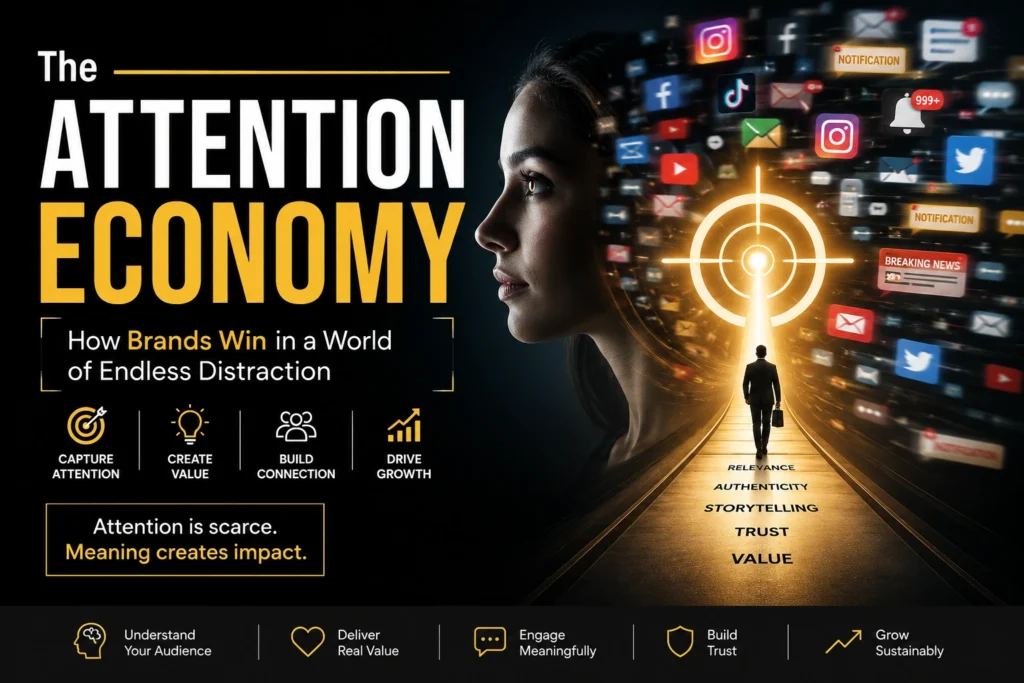
The Attention Economy: How Brands Win in a World of Endless Distraction
The New Currency: Attention In today’s digital environment, attention is among the most prized assets for companies. Every day, consumers are exposed to thousands of messages, ads, videos, notifications, emails, and social media updates. Therefore, brands now compete beyond just market share or purchasing power. They vie for a limited share of human attention. This environment has given rise to what marketers refer to as the attention economy, in which the capacity to capture and hold attention directly affects brand visibility, engagement, and growth. Moreover, consumers are becoming more selective about what merits their attention. They can breeze past an ad in seconds, skip a video after just a few moments, or overlook content that doesn’t seem immediately relevant. Thus, conventional marketing methods that rely solely on repeated exposure are growing less effective. Today, successful brands need to craft experiences that naturally attract attention instead of just demanding it. Why Attention Has Become So Difficult to Capture The contemporary consumer navigates a setting rife with ongoing distractions. Smartphones offer immediate access to social media, entertainment, news, shopping, messaging, and a wide array of other digital activities. As a result, each notification vies with another piece of information for the user’s attention. This ongoing competition has diminished the natural, undivided attention people typically give to individual brands. In addition, digital platforms have simplified content creation more than ever before. Every day, millions of businesses and creators release new content. While this development opens up opportunities, it also leads to significant content saturation. Even with a great product, a brand can go unnoticed if its message doesn’t capture attention. Therefore, marketers need to recognize that being visible does n’t ensure attention, and having attention does n’t automatically lead to action. From Visibility to Valuable Engagement For many years, marketers placed strong emphasis on visibility. Companies evaluated impressions, reach, website traffic, and ad exposure to assess if their campaigns were successful. Nevertheless, contemporary marketing demands a more in-depth strategy. Just because someone sees a brand’s content doesn’t mean they’ll remember it, trust it, or plan to buy from it. Rather, brands ought to prioritize meaningful engagement. Good content should prompt people to pause, reflect, engage, educate themselves, or take action. For instance, an informative video can address a problem, whereas a compelling story can foster an emotional connection. In the same way, an interactive social media campaign can transform passive viewers into active participants. Thus, brands should assess not just how many people view their content, but also what actions those viewers take afterward. The Psychology Behind Winning Attention Attention is closely linked to human psychology. People instinctively pay attention to information that seems relevant, surprising, emotional, useful, or personally significant. Therefore, brands that grasp audience psychology can craft messages that organically draw attention. A compelling headline, a surprising visual, a story that resonates, or a clear promise to solve a problem can quickly boost the chances of engagement. However, drawing attention should not be used as a justification for manipulation. Clickbait might bring in quick traffic, but deceiving audiences can harm credibility in the long run. Thus, successful brands strike a balance between intrigue and genuineness. They first capture people’s attention and then provide real value once that attention is gained. In this way, attention serves as the starting point of a relationship rather than a fleeting marketing tactic. Storytelling: The Brand Advantage Storytelling continues to be one of the most effective ways to stand out in the attention economy. People might forget statistics, product specs, or advertising slogansbut they frequently remember stories that evoke emotional bonds. A well-crafted brand story can convey purpose, personality, values, and identity more effectively than traditional advertising typically can. In addition, storytelling enables businesses to involve their audiences in the narrative. Rather than just claiming a product is useful, a brand can show how it transforms someone’s experience. Sharing customer success stories, behind-the-scenes glimpses, founder narratives, and community tales can help businesses seem more relatable and human. Therefore, storytelling can turn a company from a product provider into a well-known and unforgettable brand. Creativity Is No Longer Optional In a saturated digital landscape, creativity now serves as a key competitive edge. Brands can’t depend on generic promotional messages and assume audiences will remember them. Instead, they need to create unique visual identities, fresh ideas, compelling formats, and distinct communication styles. Creativity enables a brand to establish a mental connection that rivals find difficult to replicate. Moreover, creative marketing doesn’t always demand a huge budget. A straightforward concept can prove very effective if marketers grasp their audience and convey the message clearly. Short-form videos, eye-catching graphics, informative carousels, engaging polls, standout campaigns, and content tailored to cultural contexts can all draw attention. Thus, creativity must aim not just at visual appeal but also at conveying a meaningful and memorable message. The Power of Short-Form Content Short-form content has changed how brands interact with audiences online. Platforms centered on short videos have conditioned viewers to digest content rapidly. Therefore, brands need to convey their central message within a short timeframe. This does not imply that every message needs to be shallow. Instead, marketers need to master the skill of conveying valuable information in an efficient manner A successful short-form video typically starts with a compelling hook, includes valuable or engaging content, and concludes with a clear message or call to action. For instance, a digital marketing agency could start with a statement like, “ Your website may be losing customers for one simple reason,” followed by an explanation of the issue. This structure sparks curiosity while also providing value. Thus, short-form content can serve as a potent tool when brands integrate speed, relevance, and substance. Personalization: Making Attention Feel Relevant Consumers are more inclined to interact with content that aligns with their interests, needs, and situations. As a result, personalization is becoming increasingly crucial in contemporary marketing. Rather than delivering the same message to all audiences, brands can leverage customer insights to craft more personalized experiences. Tailored